Seven tips for better potato planting
Soil-borne potato diseases such as pink rot (Phytophthora erythroseptica), Rhizoctonia/stem canker/black scurf (Rhizoctonia solani), black dot (Colletotrichum coccodes) and silver scurf (Helminthosporium solani) can be controlled by the use of seed treatments or in-furrow fungicides.
One of the major benefits of using in-furrow fungicides, either on their own or in combination with potato seed treatment, VIBRANCE® Premium fungicide, is to provide protection to the stolons, roots, stems and tubers against fungal disease in soil. Managing these diseases can enhance the evenness of emergence, tuber size, clean skin finish, processing quality, visual appearance and marketable yields.
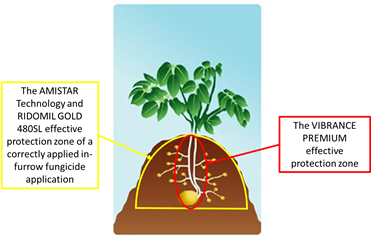
However, choosing the right product is only part of the story. For any application to be successful you need to apply it correctly and to the optimum zone of soil in order to maximize the efficacy of your crop protection program.
Consider these top tips for setting up your potato planter for effective in-furrow fungicide application:
1. NOZZLE CHOICE: Select a nozzle that gives even and uniform distribution of product, such as ALBUZ ATR 80° hollow cone nozzle, which has been evaluated in-furrow to provide excellent coverage. These will require the fitting of a hollow cone bayonet cap.
2. NOZZLE POSITIONING: Syngenta best practice recommends two nozzles be used to apply AMISTAR® 250 SC and RIDOMIL GOLD® 480SL fungicides
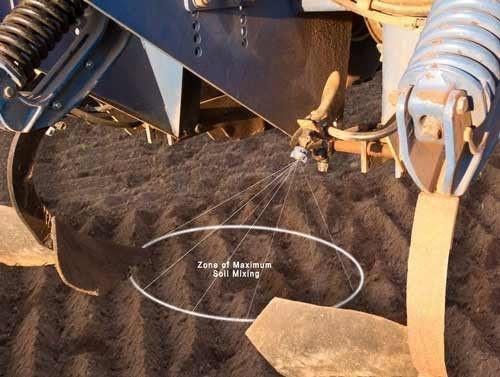
- The front nozzle should be mounted at the front of the planter inside the opener so the spray is applied just before the seed is dropped in to the furrow, to provide contact with treated soil.
- The rear nozzle should be angled to spray slightly backwards in order to spray the soil as the furrow is closing (bow wave).
Two nozzles always provides the best disease control, to ensure fungicides are applied to the tuber AND the area of “maximum soil mixing” – see photo (below).
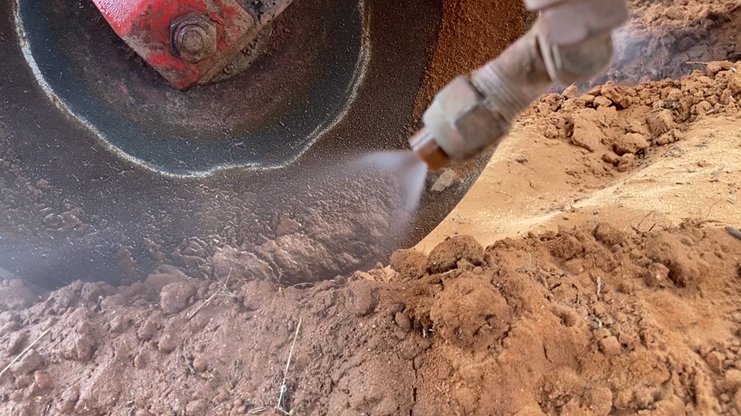
Mount the rear spray nozzle so that it is placed in a down and reverse position to spray the soil that has been returned to the furrow (bow wave).
3. AGITATION: You should have good agitation in the application unit. It is recommended to agitate at least 10% of combined tank capacity (L) + nozzle output (L/min).
E.g. a 100 L tank and 4 nozzles applying 0.8 L/min total, require a pump with a minimum output of 10.8 L/min, at normal operating pressure.
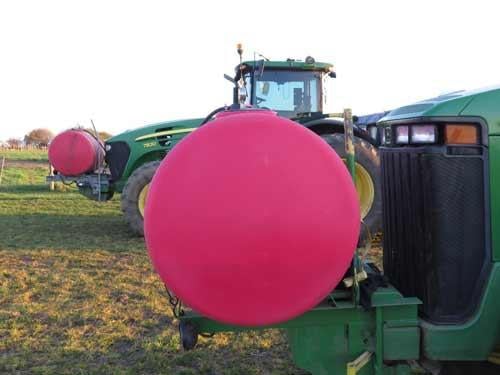
4. FILTRATION: For filtration of the unit, use 100 mesh x2 filters in the circulation system. If you can, please avoid using nozzle filters.
5. SYSTEM: Use as small a bore pipe as possible for spray lines from your valves to the in-furrow nozzles. This keeps the speed of the liquid up through the system and helps to prevent caking in the pipes.
6. CLEANING: After each day, wash out spray system, clean all nozzles and all filters, leave nozzles in bucket of water overnight and leave with clean water in circulation system.
7. REVIEW and CALIBRATE: Remember, just like a boom spray, it’s important to ensure that your in-furrow setup is doing the best possible job throughout the season. Check the positioning and output of the nozzles regularly and adjust them depending on product rate, water volume, soil flow and conditions.