Best practices for spray application
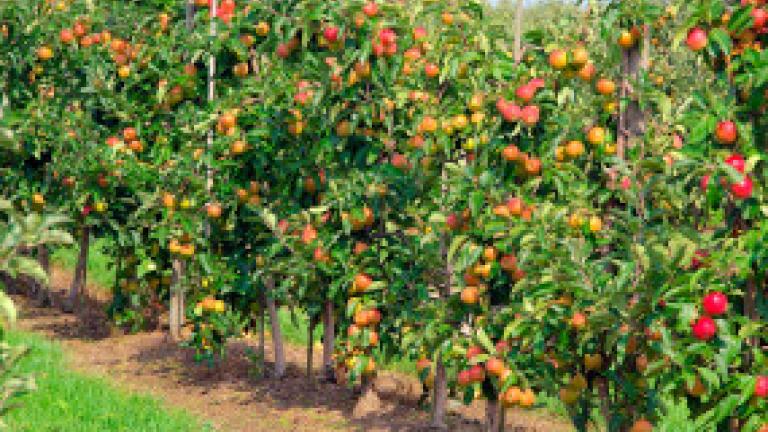
In tree, vines and trellised vegetables crops, product application rates based on ground area, expressed as rate of product per hectare, were once considered satisfactory but can easily result in the grower either under dosing or overdosing crops with product. In these crops, application rates are expressed as rate of product per 100 litres and the water volume used to apply the product should be altered throughout the season depending on the amount of foliage present to ensure the correct rate of product is applied to control the target pest or disease.
Using a fixed amount of product per hectare in tree crops and trellised vegetables is similar to having one size of clothing for your entire lifetime; as you grow, so should their clothing in order to fit their growing body.
How much crop canopy is in a hectare?
The amount of crop canopy in a hectare can vary greatly, especially as the crop grows and the area of canopy increases with it. Your canopy management strategies, irrigation or rainfall, can all subsequently influence the size of the canopy.
When using products registered in tree and vine crops (also applicable to some trellis crops) the label will sometimes stipulate a target rate per 100 L. This means you must first determine the water volume needed to spray the canopy up to point of run-off, before a water rate of application for a product can be determined. This is referred to as dilute spraying.
Dilute spraying is applying your crop protection products with any sprayer designed and/or set up to apply high volumes of water up to the point of run-off, and matched to the crop being sprayed.
The point of run-off refers to the amount of water required to wet the plant to the point where some spray droplets join together and run-off the foliage or bunches.
There are several methods that can be used to determine a dilute application rate:
- The best way is to actually get out in the orchard/vineyard and do a test spray of your orchard/vineyard to determine the volume required to reach point of run-off.
- You can estimate the volume required to reach point of run-off based on previous experience.
- Or use industry-based guideline (see below).
| Crop | Product Type | L Volume of water (L) required to wet a 100 m long row that is 1 m in height, up to the point of run-off. For every additional m in canopy height or spray height, (which is often greater than the canopy height) you multiply this number by the canopy height. | |||||
| Macadamias | Fungicides | 25 | 26 | 27 | 28 | 29 | 30 |
| Using the lower number for canopies with less dense foliage and the higher number for more dense canopies. | |||||||
For example, if you are spraying a macadamia tree with a moderate density canopy and your sprayer is set up to spray 3 m in height, to adequately cover your trees you will need approximately 27 L water to reach the point of run-off, multiplied by the canopy height (3 m), therefore 27 L x 3 m = 81 L for every 100 m of row.
To work out the volume you need in a hectare, you need to know the row spacing. If your rows are 5 m apart, you will have 20 rows 100 m long per hectare. Your dilute water volume per hectare becomes 20 rows x 81 L = 1620 L/ha.
Example
- Dilute spray volume as determined above is 1620 L/ha
- The dilute label rate for the product you have chosen to apply is 80 mL per 100 L
- You simply add 80mL for every 100 L in the spray tank and apply as a dilute application
However, in my experience very few growers are applying their crop protection products using the dilute application method. If you are not applying the product selected as a dilute spray (using a sprayer designed or set up to apply high volumes of water up to the point of run-off, and matched to the crop being sprayed) then you are considered to be concentrate spraying.
Concentrate spraying is using a sprayer that is designed and/or set up for concentrate spraying (that is a sprayer which applies water volumes less than those required to reach the point of run-off) and matched to the crop being sprayed.
If you are concentrate spraying, you need to do a few calculations to ensure you are applying the crop protection product at the correct rate. You must determine an appropriate dilute spray volume (see example above above) for the crop canopy.
The mixing rate for concentrate spraying can then be calculated in the following way:
Example
- Dilute spray volume as determined above 1620 L/ha, however, you choose to apply the product using a water volume of 1000 L / ha
- You then need to calculate the concentration factor (CF). In this case it is worked out by dividing the dilute volume (1620 L) by your application volume (1000 L) = 1620 L/1000 L= 1.62
- The dilute label rate for the product you have chosen to apply is 80 mL per 100 L, then the concentrate rate becomes 80 mL/100L x the CF 1.62
That is, 80 mL x 1.62 = 129.6 mL product /100 L water
- You then simply add 129.6 mL for every 100 L in the spray tank
No matter which method you choose to use, the sprayer should be set up to achieve even coverage throughout the entire crop canopy using your chosen water volume.
Some watchouts when working some of this out include:
Remember the height of the crop is not always the height to use to calculate your dilute rate. If your trees are 1.5m in height but your sprayer is set up to deliver the spray over a width of 2m then you need to use the sprayer height (2m) to determine the dilute application volume.
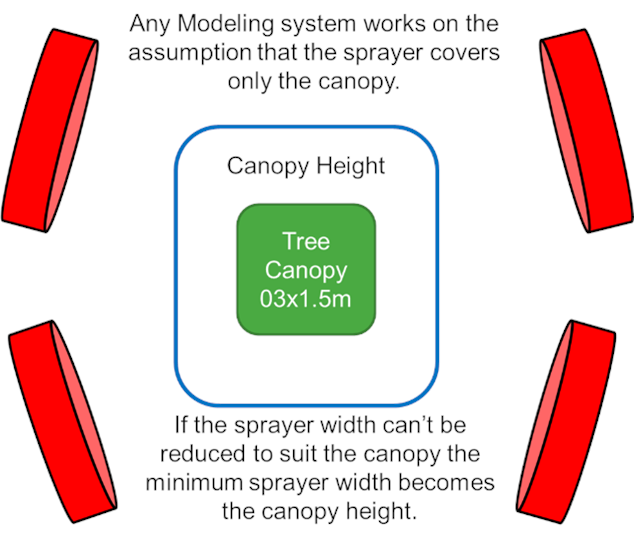
- Leaves on the tree or vine close to the sprayer will usually reach point of run-off before the inner canopy.
- Aim to adequately cover the inside of the canopy before run-off on the outer surfaces occurs by adjusting your machinery.
- Run-off has not been achieved if the spray is dripping off the outer leaves, but the inside of the canopy is mostly dry.
Before you make your next spray application, be sure to review the product label requirements and consider your spray equipment capabilities to achieve optimal crop coverage. This will help you achieve the best possible results without wasting your time or money.
Further reading:
Technote: How to conduct a simple physical compatibility jar test
ENDS
About Syngenta Australia
Syngenta is a leading agriculture company helping to improve global food security by enabling millions of farmers to make better use of available resources. Through world class science and innovative crop solutions, our 28,000 people in over 90 countries are working to transform how crops are grown. We are committed to drive positive change in agriculture and embed sustainability across all aspects of our business.